The union of the grotesque and the sublime
The Man Who LaughsThe union of the grotesque and the sublime is a governing contrast in the novel: what appears ridiculous or disturbing can also expose profound suffering, while what exceeds human understanding inspires both dread and reflection. In Gwynplaine, the contrast becomes a public ordeal. His fixed comic appearance contradicts his grief and eloquence, so that the very sign by which others recognize him obscures what he means. The novel develops a related tension through images of the dead and the sea, where material helplessness and overwhelming scale prompt speculation about justice, spirit, and human limits.
Definition and Operation
The grotesque and the sublime meet where a visible contradiction resists easy interpretation. In Gwynplaine’s case, the outward comic effect does not match the inward state: emotion rises as sobbing, yet becomes uncontrollable laughter. The response of the assembly follows the appearance rather than the appeal. His words ask to be heard as an expression of suffering, but his face directs attention toward comedy. The mismatch is not a passing disguise; it governs how the scene is received and makes communication itself part of his distress.
The sublime operates differently, through forces and realities that exceed ordinary comprehension. The text describes the hurricane as a cry that is neither speech nor thunder, emerging from a cosmos imagined as blind, obscure, and immense. That language does not explain the storm by reducing it to a human intention. Instead, it approaches the force indirectly, through scale, sound, and the limits of understanding. The grotesque exposes a disjunction within human perception; the sublime makes perception confront what it cannot master.
Gwynplaine and the Public Misreading
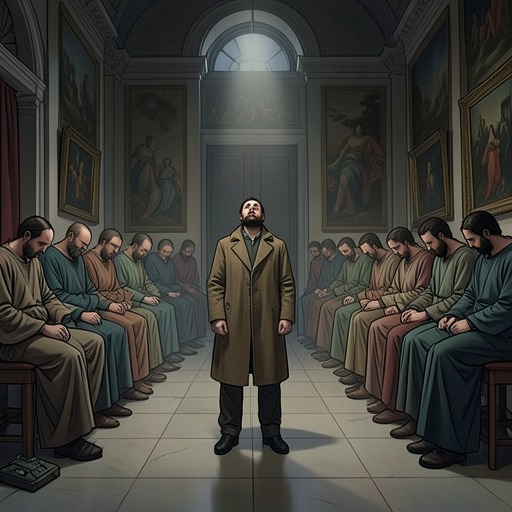
At the parliamentary address, Gwynplaine’s emotions and public appearance pull in opposite directions. A sudden surge of feeling brings sobs to his throat, but the physical response becomes involuntary laughter. As it intensifies, the extravagant quality of his words also amuses the assembly. The result is a double failure of reception: his speech carries an appeal, while his face seems to contradict it, and the audience responds to the comic effect rather than the pain he is trying to convey.
Gwynplaine identifies himself not as an isolated oddity but as a representative of ordinary people set against those who treat themselves as the norm. He turns the charge of monstrosity back on his audience, presenting their apparent normality as the exception to a larger social reality. In his argument, the laugh is both an accusation directed outward and a torment borne inward. This reversal gives the grotesque a political force: the appearance that makes him an object of amusement becomes the means by which he indicts the privileged assembly. Yet the reversal cannot control how he is seen. His eloquence, anger, generosity, love, and grief remain liable to be mistaken for spectacle.
The narration frames this collision as a bond between the grotesque and the sublime: laughter echoes grief, parody follows despair, and appearance opposes being. Gwynplaine is at once elevated into a position among the powerful and treated as an entertainer whose distress is not believed. His rise does not dissolve the old misreading; it relocates it. The audience that once enjoyed the comic figure can continue to see a buffoon even when he speaks from within the political institution he is challenging.
The Dead and the Unknowable
The novel extends this aesthetic conjunction beyond Gwynplaine. The sight of an unburied dead man becomes an occasion for thought because the body is more than an inert object in the observer’s imagination: it is understood as the ruined dwelling of a once-living spirit. The dead man appears as a sign and a testimony, bearing the traces of human vengeance while seeming to await a justice beyond human law. The scene does not resolve whether such justice will arrive. Its force lies in the unsettling gap between material remains and the spiritual or moral meanings people perceive in them.
This passage links bodily materiality to speculation without making the unknown fully legible. Certain places and objects seem to open dark thresholds in thought; the mind approaches them through conjecture rather than certainty. The sublime here is not simply grandeur. It is the pressure of an unanswered possibility, made more disturbing by the visible evidence of death. As with Gwynplaine, what can be seen does not settle what the sight means.
Sea, Helplessness, and Significance
The sea and shipwreck carry the same contrast into the natural world. Shipwreck is defined through incompatible conditions: land appears near but cannot be reached; something seems firm but proves fragile; a person remains alive while surrounded by the prospect of death. The castaway is confined by open space, suspended between sky and ocean, and dependent on the very elements that also hold him fast. Such helplessness makes the sea seem at once empty and absolute, a power beyond the sufferer’s command.
The ocean’s changing behavior intensifies the uncertainty. Violence may give way to quiet intervals, and a wreck may be hurried onward or delayed, as though the sea alternated between force and caress. This language gives nature an almost playful agency, but does not establish that the ocean acts according to human purposes. Rather, its shifting moods make human expectations inadequate: neither hope nor despair can reliably predict what comes next. The scene’s fearful grandeur arises from the contrast between the sea’s immense freedom and the person’s inability to direct even a small movement.
Across these scenes, the grotesque and the sublime expose different forms of misproportion: the distance between Gwynplaine’s expression and his suffering, between a dead body and the questions it provokes, and between human need and the scale of the sea. The parliamentary audience converts pain into amusement; the observer of the dead confronts meanings that cannot be confirmed; the shipwrecked person faces forces that cannot be negotiated with. The recurring effect is not a simple reconciliation of opposites. It is the persistence of a divide between what appears and what is endured, leaving pity, judgment, and understanding in tension.